What is a CBCT image or 3D X-ray?
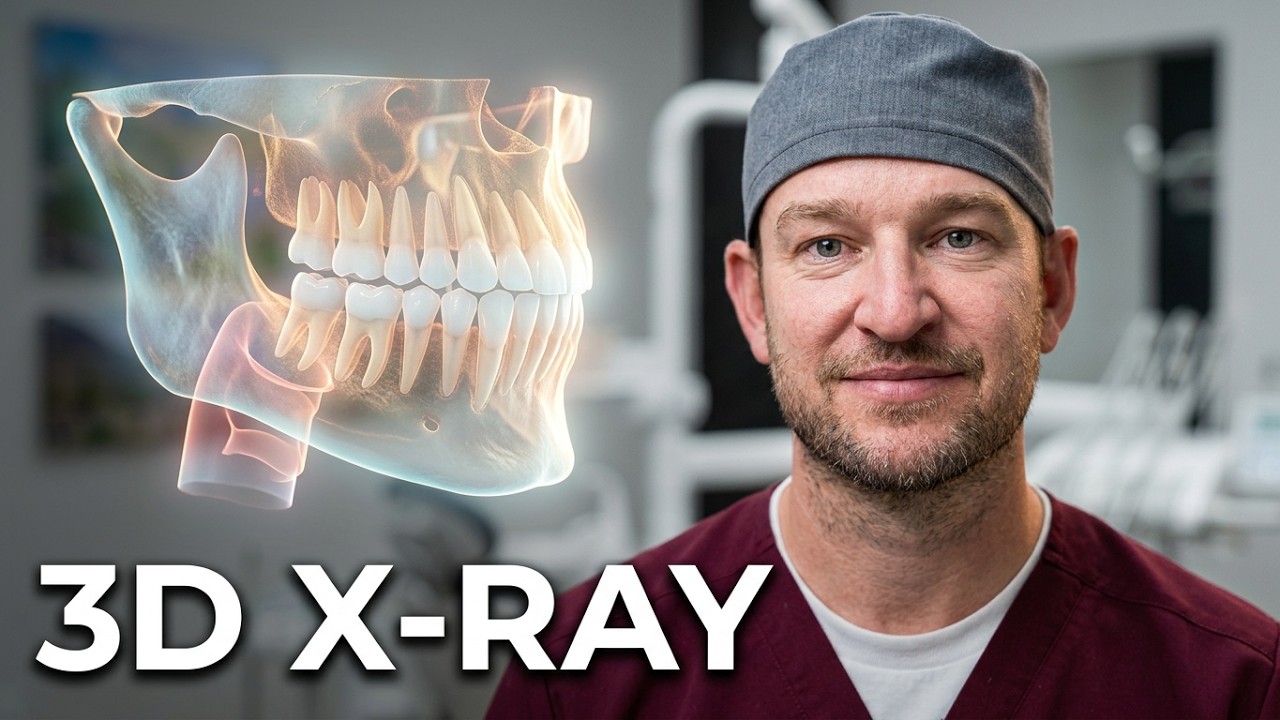
A CBCT scan is a specialized dental X-ray that's different from traditional X-rays because it creates a 3D volumetric image, whereas a conventional dental X-ray is a 2D image.
With a 2D X-ray, the appearance of teeth and surrounding structures can be affected by the angle of the image. A CBCT gives us a three-dimensional view that allows us to evaluate and measure structures from different directions, which can be very helpful when we're planning certain types of dental treatment.
How does a CBCT scan work?
A CBCT scan works by using a cone-shaped X-ray beam that rotates around your head and captures many images, or small slices. The scan itself can be completed relatively quickly, depending on the machine and the type of scan we're taking.
When the machine is done, the dental software takes all that raw data and converts it into a volumetric 3D image. As the technology has advanced, newer equipment and imaging protocols have also allowed us to obtain the diagnostic information we need while managing radiation exposure.
Why are CBCT 3D X-rays useful in dentistry?
CBCT 3D X-rays are extremely useful in dentistry because they allow us to evaluate dental and surrounding structures in three dimensions. We can look at the bone and teeth from different angles and take measurements that help us plan treatment.
In addition, when we're doing procedures such as implant planning or certain root canal treatments, a 3D image can provide information that may be difficult to see on a 2D image because structures can overlap. Having that additional information ahead of time can help us plan the procedure more thoroughly.
When would a dentist recommend a CBCT image?
A dentist may recommend a CBCT image for procedures such as dental implant planning, certain extractions, or root canal therapy. For example, teeth can have complex root and canal anatomy that isn't always completely visible on a conventional 2D X-ray. A 3D image may give us additional information that helps us plan treatment.
We determine when a CBCT is appropriate based on the individual patient's diagnostic and treatment needs. The goal is to use 3D imaging when the additional information it provides is useful for the patient's care.
How are CBCT images used for dental implants and root canal therapy?
CBCT images are used to plan for dental implants or root canal therapy by creating a 3D volumetric image of the area we're treating. We can also use equipment such as CEREC or other intraoral scanners to create a digital model of your teeth.
With implant planning, we can combine that information in our software so we can evaluate where the teeth are in relation to the bone and other important anatomy. This helps us plan the position of the implant before the procedure. With root canal treatment, CBCT imaging may help us evaluate complex anatomy or other findings that aren't as clear on a conventional X-ray.
What can a 3D image show that traditional X-rays cannot?
Traditional dental X-rays give us a two-dimensional view of a specific area. With a 3D image, our field of view can be much broader depending on the type of CBCT scan we're taking.
We may be able to evaluate structures such as the teeth, jaws, jaw joints, sinuses, and nerve pathways. CBCT imaging can also provide additional information about bone defects, certain infections or lesions, and other areas that may be important for diagnosis or treatment planning.
What are the limitations of a 3D dental X-ray?
One limitation of a 3D X-ray is that it isn't necessarily the preferred imaging method for detecting cavities between the teeth. Conventional intraoral X-rays, such as bitewings, can provide better information for detecting this type of tooth decay. Different types of dental imaging are useful for different purposes.
What should a patient expect during a CBCT scan?
A patient who's getting a CBCT scan can expect a relatively quick and straightforward experience. Depending on the unit, you may bite on a small positioning guide while the machine rotates around your head. The main thing you need to do is remain still while the scan is being taken.
Once you're done, the machine processes the information, and our computer software creates the 3D images that we can review.
How much does a CBCT scan cost?
A CBCT at our office is around $250, whether we're taking a small field or a larger image. Costs at other offices can vary depending on the type of scan, the equipment being used, and the services included.
How safe are CBCT scans?
CBCT scans use ionizing radiation, so we want to use them when the diagnostic information they provide is appropriate for your care. The amount of radiation varies depending on the machine, field of view, imaging settings, and type of scan.
As CBCT technology has improved, newer equipment and imaging protocols have allowed us to obtain useful images while managing radiation exposure. We consider the reason for the scan and use appropriate imaging settings for the information we need.
When might a baseline CBCT be helpful?
One of the useful things about CBCT imaging is that we can see structures beyond what we normally investigate with a conventional 2D dental image. Depending on the field of view, that may include areas such as the jaw joints, sinuses, teeth, bone, and nerve pathways.
However, we don't take a CBCT simply to look for every possible condition. We recommend the scan when there's a clinical or diagnostic reason for obtaining that additional three-dimensional information. If something unexpected appears on the scan, it may need further evaluation.
What should you know about who reviews your CBCT scan?
If you're getting a CBCT scan, it's important that the images are appropriately reviewed. Dentists who use CBCT imaging receive training in working with these images, but there may be findings that require additional interpretation.
If there's something we're unsure about or something outside the areas we routinely evaluate, the scan can be referred to an oral and maxillofacial radiologist for further review. That's another resource we can use when a CBCT shows something that needs additional evaluation.
Understanding your dental care options is an important part of protecting your oral health. Contact us at (970) 514-0662 or email [email protected] with any questions.